
On, May 20th, 1935, while the St Mihiel sloshed woozily northward full of seasick Midwesterners, the Anchorage Times reported two news items out of Palmer.

The first was that the newest town on the Railbelt could now apparently field a baseball team. This was of great interest to Anchorage, a town that was mad for baseball in its early decades.
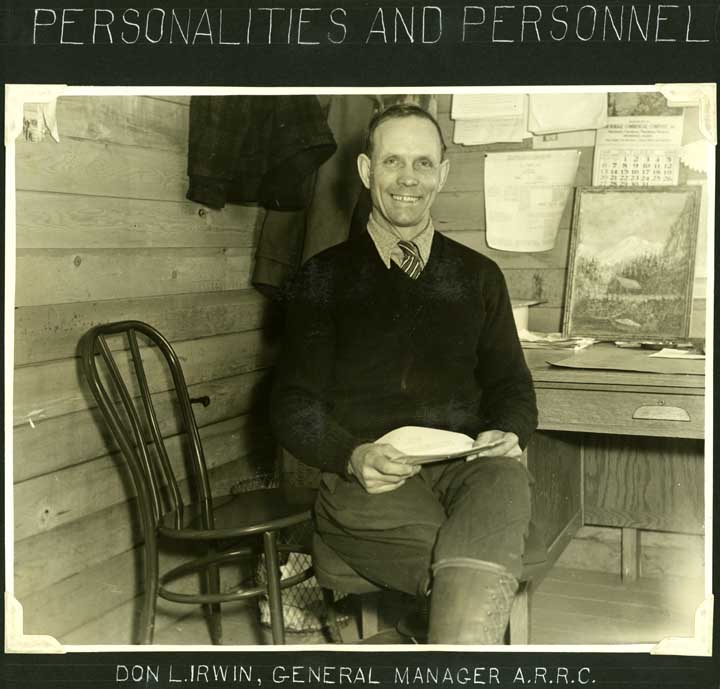
The second was that Don Irwin, General Manager of the ARRC, announced he would stay on with the Matanuska Colony project and even participate as a farmer, rather than returning to his prior job running the Matanuska Experiment Station farm on Trunk Road. Back in March he had taken a temporary two-month leave of absence from the Experiment Station to go to DC to help organize the ambitious resettlement project, and had returned to Palmer in early May with the first wave of workers.

Photo
“Don L. Irwin, General Manager A.R.R.C.”
From the ARRC photo album, Mary Nan Gamble Collection, Alaska State Library
Irwin is the namesake for the Irwin Exhibits building at the Alaska State Fair. He was the most popular of the Colony managers, and his local knowledge was appreciated by the colonists, if not always by the government officials attempting to organize the project from DC. He served as general manager until fall of 1935, and as assistant manager until June of 1936, when he returned to the Experiment Farm. Later, in 1945, he returned as manager for the ARRC for another two years, after its role had changed from building a town to administering farm loans.
Irwin wrote a book, “The Colorful Matanuska Valley,” about the history of the Valley and an inside view of the Colony. Every book about the Matanuska Colony mentions him; Orlando Miller’s “The Frontier in Alaska and the Matanuska Colony” is a particularly good source.
“Of the four men who were managers of the colony in its first ten years . . . Irwin was the most popular. In the first summer, after the complaints began and the FERA sent additional representatives, Irwin had the advantage of being present, sympathetic, and not really responsible for the colony’s troubles. Later, as assistant manager [fall 1935-summer 1936], he could persuade, coax, and jolly colonists into good humor while bearing no blame for general colony policy, which was the affair of the ARRC and the general manager. By the time he became general manager again in 1945, when the troubles of the colony had largely passed, he appeared to be an old friend mingling familiarly with the valley people, reporting the activities of the community, tending to ARRC mortgages and loans, but not interfering.”
