
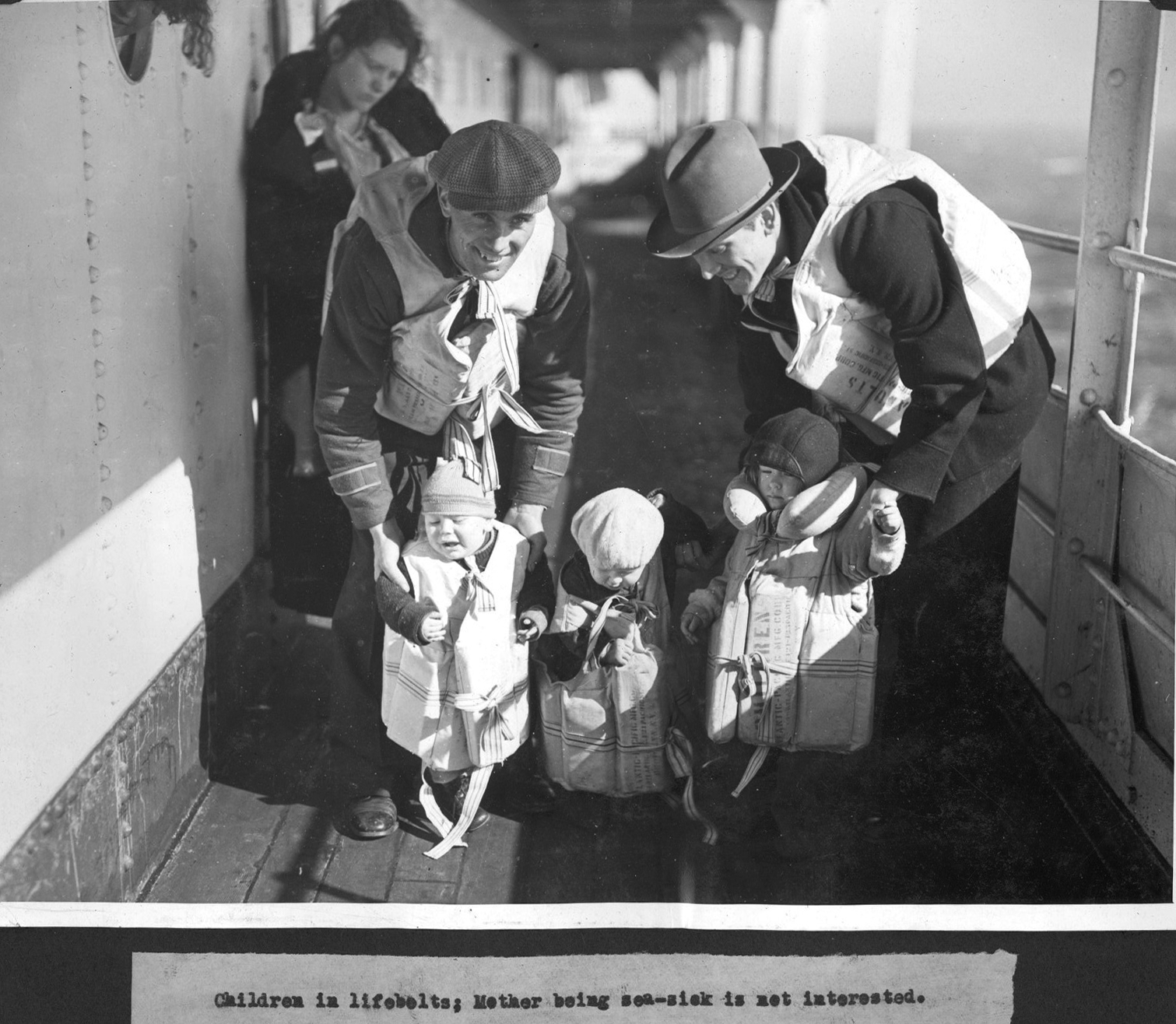
On May 21st, 1935, the Michigan and Wisconsin farmers bound for Palmer were one day out from Seward, and very eager to reach land. The second voyage of the St. Mihiel for the Matanuska Colony Project was a lot more miserable than the first, and most of the passengers suffered mightily from seasickness.

Photo from the Mat-Su Borough Sandbote collection, held by PMHA.
“Children in lifebelts; Mother being sea-sick is not interested.”
Margaret Miller wrote home on May 28, 1935:
“The trip on the boat (Army Transport St. Mihiel) was terrible! We didn’t take the inside passage as had been planned, but, because of the overload we cut right across in a straight line from Seattle to Seward. They had three thousand eight hundred tons of freight on the boat – besides it’s being overcrowded with people. Mothers with small babies were crowded into state rooms and the rest of us were herded into hatches, below water line. (Men and women in separate hatches). We were very closely quartered. Nearly everyone had colds – there were very poor accommodations for laundry – the wash rooms and toilets (though very clean at the outset) soon became positively revolting – and all together, along with being seasick, the whole thing was just one terrible nightmare.”
Excerpt from “Cheechako to Sourdough: Excerpts from a
Colonist’s Diary of the Matanuska Colonization Project” by Margaret Miller, in
the PMHA Miller collection.

Arville Schaleben, Milwaukee Journal reporter riding along with the colonists, tried to put a cheerful spin on the voyage.
“Pioneers Get Touch of Sea,” Milwaukee Journal, May 20th 1935.

“Oh yes, and the dogs howl so loudly that it is hard to sleep at night. They are seasick too.”
Arville Schaleben, “Colonists Near Alaskan Goal,” Milwaukee Journal, May 21st 1935.

Captain Roland K. Charles, Jr., MD, of the Army Medical Corps, served aboard the St. Mihiel and wrote a report for the Army Medical Bulletin about the two voyages of the St. Mihiel in service of the Matanuska Colony Project. His perspective illuminates the vastly different experience of the first contingent of Minnesotans, and the second contingent from Wisconsin and Michigan.
Of the first voyage, May 1st from San Francisco, he wrote:
“The S.E.R.A. enrollees [the transient workers of the California State Emergency Relief Administration] were used for the necessary work details and were of invaluable assistance. The weather was good most of the time; the morale of the ship was excellent; and the few complaints registered were ironed out by the diplomacy of the ship’s officers. The children played hard during the entire trip, and little or no trouble occurred among them. None were injured. A piano was placed aboard by one of the settlers, and with the ship’s drums, wind, and reed instruments, plus a guitar, violin and harmonica supplied by the passengers, a makeshift orchestra blared forth from morning to night. Much dancing and singing prevailed.”

AP photo from the (Juneau) Alaska Empire, May 10th,
1935, captioned:
“There was a medical staff aboard the ship. The staff, upper left, included (left to
right) Capt. R. J. Charles, Jr., Army medical officer; A. A. Hansen and Nurse
Madeleine De Foras.”
“The second trip (from Seattle) was very unsatisfactory. The start was fine, but this ceased as soon as the ship pulled away from the dock. . . The ship was heavily loaded with cargo, including about 8 long radio mast poles for the Signal Corps in Alaska, 4 modern Ford busses, 53 yapping dogs, 2 cats, and 4 ducks. There were 2 staff members and 1 press representative; and 573 settlers making up 128 families, with 146 children below 5 years of age and 103 children between 5 and 12 years old. . . These settlers were from northern Michigan and Wisconsin; they made a slightly better appearance but were not so hearty as the first contingent . . . The families were larger . . .; the general attitude was not good; they had experienced a hard railroad trip across the continent; many were sick; and they were not allowed much rest while in Seattle because of the attempted entertainment. Miserable seas accompanied the entire trip. . . Seasickness among the men, women, and children was excessive and severe. . . Insufficient men were available for proper cleaning of the rooms, hatches, and rendering of even necessary service. There were no transient enrollees to assist in the work . . . The absence of the very efficient Red Cross nurse of the first trip for social service work was apparent.”
From “Notes on the Matanuska Project” for the Army Medical Bulletin, Roland K. Charles, Jr., Captain, Medical Corps, U.S. Army.
