In the first week of June, 1935, the early rumblings of dissent and division among the Matanuska colonists took the form of complaining about each other’s dogs at council meetings. Since the situation at Palmer was going to the dogs, today’s post is about the canine members of the Matanuska Colony Project.
Arville Schaleben, while riding west from Wisconsin with the colonists, reported:
“By the closest count possible, there are seven dogs on the train. They are aboard through the influence of David R. Williams, supervising architect for the rural rehabilitation division in Washington. When he was young he had to leave his dog behind on a long trip and he still feels badly about it. He insisted, therefore, that the colonists be permitted to take dogs with them.”
Arville Schaleben, “Colonists Nearing Coast and Seattle Celebrations,” Milwaukee Journal, May 16th 1935.
Illustration by Einar Quist for the Milwaukee Journal, appearing May 15th, 1935.
In Seattle, amidst all the hubbub and grand fuss made over their arrival, some colonists played a prank on Governor Martin of Washington, interrupting his handshaking and baby-kissing with a swaddled-up pup.
Clip from Arville Schaleben, “Officials Beam, Crowds Cheer State Pioneers,” May 17th 1935
The canine component of the project increased along the way. Schaleben reported “Bernice Piaskowski of the upper peninsula left home with one terrier dog. Now she has six. Rambler bore five pups in a Great Northern baggage car.”
One puppy, either from Rambler or another dog on the project, found a home on the St. Mihiel with the ship’s captain.
Photo from the ARRC album: “Captain Pumphrey takes a lesson in nursing from Red Cross Nurse Madeleine de Foras, as he feeds his puppy ‘Matanusky’ born en route Matanuska.”
Quote from Arville Schaleben, “Officials Beam, Crowds Cheer State Pioneers,” May 17th 1935
Upon arrival in Seward, colonist George Emberg worried about his dog getting hurt by the Alaskan huskies and malemutes who greeted the ship, until he realized the Seward dogs weren’t as fierce as they looked.
Besides the original colonist pets and new puppies, the St. Mihiel also brought a passel of Seattle hounds to Alaska. Reverend Bingle recalled how the second contingent of colonist families “came by way of Seattle and as Seattle wishes to do things bigger and better she pushed off on those new farmers all the stray dogs out of her dog pounds. It was interesting to see them arrive.”
According to Ray Rebarchek, one of those Seattle strays was claimed by young Jalmar Kerttula, who named it “Tatters.” Jalmar’s mother Elvi absentmindedly said yes to his question of if he could have a dog, forgetting that with a bunch of unclaimed dogs in camp, it was not a merely hypothetical question.
Photo from the official ARRC photo album, Mary Nan Gamble Collection, Alaska State Library. “An Alaskan husky greets the newcomers at Seward.”
Quote from “The First Three Years” by B.J. Bingle.
Anecdote about Tatters from “Memoirs of an Alaskan Farmer” by Ray Rebarchek.
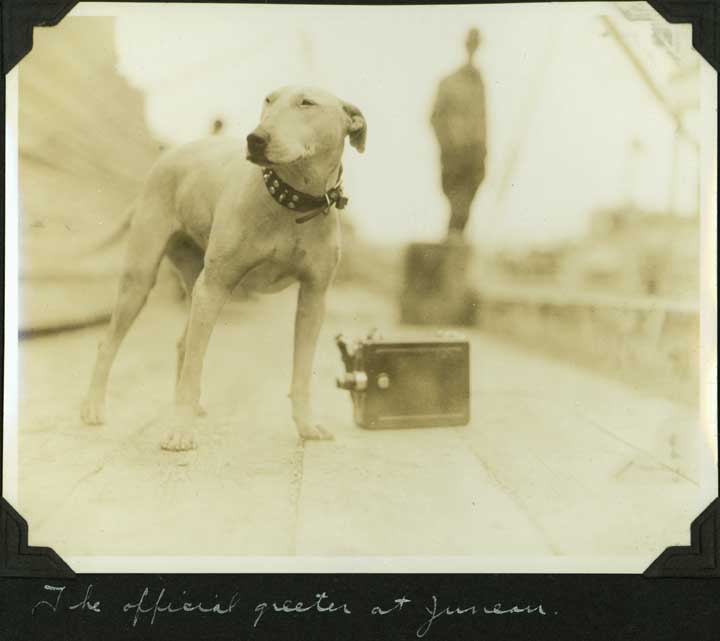
The transient workers and ARRC officials aboard the North Star had a brush with canine fame on their journey to Palmer. William Geist, the ARRC’s photographer, stopped to snap a portrait of “The official greeter at Juneau,” a bull terrier named Patsy Ann. Known for greeting every ship to arrive in town, Patsy Ann would become the subject of books, memorialized in a bronze statue on the Juneau docks. A website devoted to her claims she was “the most famous canine west of the Mississippi, more photographed than Rin Tin Tin.”
Photo from the ARRC photo album.
Pearl and Marcella Vasanoja with their family dog Chummy, brought up from Minnesota, in front of their tent in Camp 8, summer 1935.