Thursday, May 30th, 1935, was Memorial Day (it would not be moved to the last Monday in May for another 33 years). In Palmer, the holiday was observed in the newly cobbled-together temporary meeting hall. “Memorial Hall” would serve as Palmer’s first church, rec building, and even library – for about a month and a half, until an outbreak of disease spurred its overnight conversion into a hospital in mid-July.
Reverend Bingle’s account of building the first church/community hall, from his booklet “The First Three Years.”
Copies of this booklet are in the PMHA Miller collection and the Juster Hill collection held by Palmer Historical Society.
A photo of the community hall in use on July 4th, before its conversion to a hospital. At some point in the past month the canvas roof had been replaced with wood.
Arville Schaleben photo from the Juster Hill collection held by the Palmer Historical Society.
Schaleben’s caption: “This building, built as a temporary recreation hall, was converted into a hospital in six hours to isolate scarlatina and scarlet fever cases when they broke out in colony.”
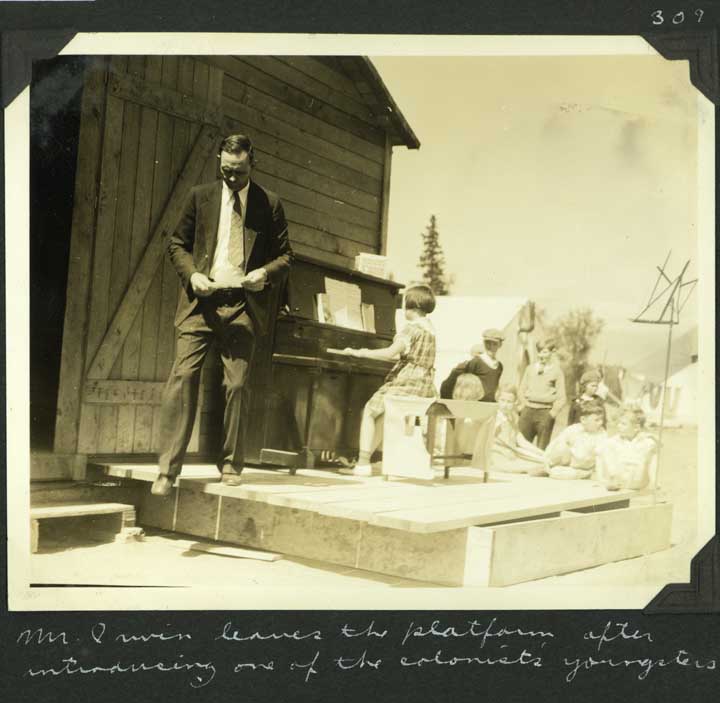
From the official ARRC photo album, Mary Nan Gamble collection, Alaska State Library. “Mr. Irwin leaves the platform after introducing one of the colonist’s youngsters.”
Arville Schaleben, “Colonists Voice Thanks for New Chance in North,” Milwaukee Journal, May 31st, 1935.
Arville Schaleben reported in detail on the Memorial Day observances.
“Lester N. Troast, the Alaskan architect on the project, spoke briefly in dedicating the building.
‘I dedicate this hall to no religion, to no social group, but to you pioneers of Alaska,’ he said. “Let’s call it Memorial hall. Let’s dedicate it to those brothers and sisters and fathers who are not here. May it be of service to us in making this project succeed.’”
Of interest is Bingle’s observation that “40 or 50” colonists were WWI veterans. Selection criteria to join the Colony Project preferred applicants between 25 and 35 years old, so most of the men had been too young for the last draft – but, still, a good chunk of the group were in their late 30s or 40s, old enough to have been of fighting age before the war ended.