This week, in 1935, all but the last few colonist families arrived in Palmer and every family assigned a farm tract, the major work of the Colony was to get families moved out to camps near their farms, so they could begin clearing land and building houses.
Map from Kirk H. Stone, “Alaskan Group Settlement: The Matanuska Valley Colony” (US Dept of the Interior Bureau of Land Management, 1950), p. 26.
Camp 1, aka Perkins – headquarters for the construction division, near the current fairgrounds
Camp 2 – near the Experiment Farm
Camp 3 – Palmer
Camp 4 – was furthest out, almost to Seward Meridian on the Palmer-Wasilla Highway, or as it was known then, on the Wasilla-Finger Lake-Palmer Road.
Camp 5 – at the intersection of Palmer Fishhook Road and the Werner Cutoff. The Werner Cutoff became what’s now the first two miles of Palmer Fishhook. Camp 5 was right at the end of this straight stretch.
Camp 6 – north end of Farm Loop, near the Moose Creek Road (now the Glenn Highway)
Camp 7 – Palmer Fishhook, just north of Wasilla Creek
Camp 8 – Springer System, southwest end
Camp 9 – Springer System, southeast corner
Camp 10 – the Butte
Photo from the official ARRC album, Mary Nan Gamble collection, Alaska State Library. “Site of colonists’ camp No. 2. 2 p.m. May 17th. Photographed during a hail storm.”
Irwin comment about rain from Arville Schaleben, “Alaska Colony Grumbles About Shortage of Tents,” Milwaukee Journal, May 30 1935.
The transient workers’ efforts to build the camps had been slowed by rain and mud. Don Irwin said the spring rains in 1935 were the heaviest since 1917 (when the Experiment Farm on Trunk Road started keeping weather records).
Photo from the ARRC album. “Ford truck being pulled out of mud by a caterpillar.”
Even when the camps were ready, getting to them was an ordeal.
Margaret Miller recalled:
“On that first morning [May 25th] we rode out from Palmer, the roads were so muddy from heavy rains that we had to give up trying to reach camp by bus. We walked the last half-mile to our new ‘home’ through calf-deep mud.”
“We would not have had any dinner – but for the kindness of some transients who were working here. They gave us their leftover sandwiches and coffee from their lunches. That night about nine-thirty, one of the men in charge at Palmer came out and discovered we had no food so he went back and got us a few supplies. The road out here to Rosslyn was so muddy that even the Caterpillars wouldn’t come through but got stuck and the men of the camp had to go to help.”
First quote from “A Creek, a Hill, and a Forty – Margaret Miller’s Story” by Ray Bonnell.
Second quote from “Cheechako to Sourdough – Excerpts from a Colonist’s Diary” by Margaret Miller, in the PMHA Miller collection.
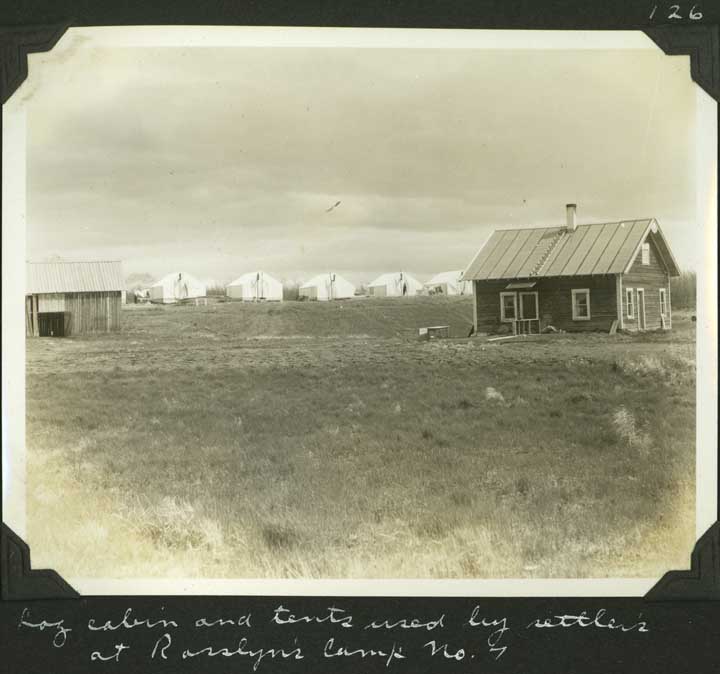
Photo from the ARRC album. “Log cabin and tents used by settlers at Rosslyn’s Camp No. 7”
Margaret Miller recalled:
“Our camp was Camp Roselyn, later known as camp 7, and it was about 5 ½ miles from Palmer. The forty upon which it was located adjoined our forty. Most of the camps were quite large, but ours had only eight tents.
We in camp 7 were fortunate since the camp was on an improved tract with a house and well. We only had to go 100 yards for water. Some camps had no water facilities, and until wells were drilled, water was hauled from Anchorage in tank cars, and distributed to the camps by truck.”