
On Friday, May 24th, 1935, most of the Michigan and Wisconsin colonists arrived in Palmer. While their men had gone on ahead to participate in the land drawing on the 23rd, the women and children had been forced to wait aboard ship in Seward due to delayed construction of tents. The town was still short on shelter by Friday evening, but everyone would have to make do.
Anchorage, eager to participate in the exciting social experiment happening nearby, provided entertainment to mark the occasion – some
carefully organized by the Booster Club, some unauthorized from a rogue pilot.

Photo from the official ARRC photo album, Mary Nan Gamble collection, Alaska State Library. “Second contingent women colonists leaving boat for train at Seward.”
Margaret Miller recalled:
“We were only too glad to get onto the train Friday morning bound for Anchorage. That trip might have been pleasant with all the gorgeous scenery along the way, if we had not all been so tired, and dirty, and ‘icky’ feeling. The babies – ranging in age from 11 days on – were all upset – off feed – cross – sick – tired; and it was such a crying, quarreling confusion.”
Excerpt from “A Creek, a Hill, and a Forty – Margaret Miller’s story,” by Ray Bonnell, 2024.

The Anchorage Times broke out purple prose to describe the welcome luncheon put on for the second contingent of colonists, though while the Minnesotans two weeks ago had been greeted with a lavish all-Alaskan feast, the larger Wisconsin/Michigan contingent were treated to a simpler affair of sandwiches and salads.
Anchorage Times, May 24th 1935.

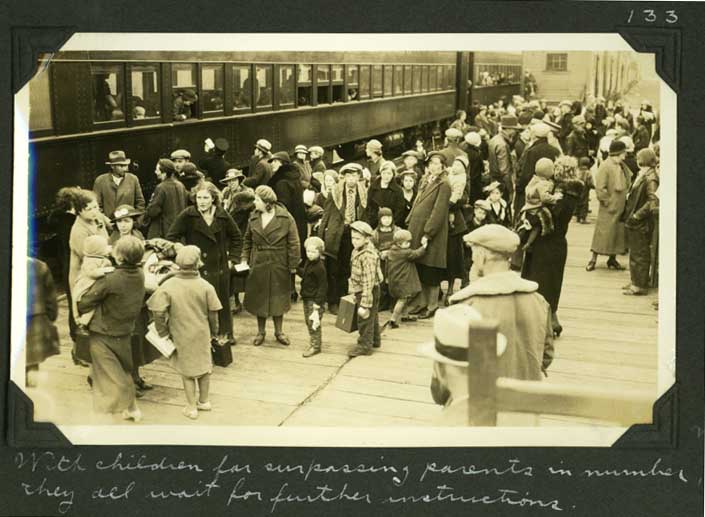
Photo from the ARRC album, “With children surpassing parents in number they all wait for further instruction.”
Sarah Kavasharov, daughter of homesteader T.A. Smith, recalled the arrival of so many new people in her autobiographical novel “Growing Down,” in which she gave herself the pseudonym Annie.
“It was a project of the United States Government, she learned, to send hundreds of people called colonists to the Valley when she had been a baby. Annie’s older brothers and sisters buzzed about it, infecting Annie’s babyhood with an excitement of the unknown, and then telling their tales over and over about meeting so many new kids at once, and about how, when they knew the colonists were coming, Mary and Walter skipped school to go down and watch the train come in, wanting to see what a colonist looked like. They were disappointed to see that colonists were only people, and their kids just looked like kids.”
The half-Native Smith children were classmates and friends with the Colony Kids, but experienced racism and difficulties with the “flock mentality” of their neighbors. While a work of fiction, Kavasharov’s novel is a vivid and detailed portrait of Palmer in the late 1930s and 1940s and the massive impact of the Matanuska Colony and WWII, from the perspective of a family that had an entire town show up suddenly on their doorstep.
From “Growing Down: A Novel of Reminiscence and Remembrance,” by Sarah Kavasharov, 2012.


The excitement of arrival in Palmer was heightened by an unexpected and unwelcome air show. Arville Schaleben reported that a pilot from Anchorage buzzed the train as it pulled in, then returned later that afternoon to fly more stunts and crash in a field.
The reckless pilot, Jack Waterworth, was one of three founders of Star Air Service in Anchorage in 1932, which eventually became Alaska Airlines. Histories of Alaska Airlines mention that Waterworth left the company in 1935 (possibly over this incident) and worked as a pharmacist at Loussac’s drugstore.
Clipping from Arville Schaleben “Alaska Perils Have Altered,” Milwaukee Journal, May 26 1935.

Photo from the ARRC photo album, “Train with women arriving in Palmer.”


Reverend Bingle wrote:
“Just before the building [meeting hall] was completed Wisconsin and Michigan families arrived. They came by the way of Seattle and as Seattle wishes to do things bigger and better she pushed off on those new farmers all the stray dogs out of her dog pounds. It was interesting to see them arrive.
But before they finally put into the woods where the seven newly constructed tent towns were, old Mother Nature had played her old Alaskan game. Not only was the frost at that time leaving the ground but the clouds had poured down water steadily for nearly 60 hours. What those roads were like no one could tell unless he had seen them personally.”
Bingle described the difficulties muddy roads and rainy weather the week before had posed for the transient workers trying to haul building materials out to the camps in preparation for the incoming families. (With the land drawing completed, the central tent city in Palmer would be broken up and families would move out to smaller camps near their tracts.)
“When the train did arrive bringing in those folks the elements had so played their part that a great portion of the families had to remain on the train all night, except what families the Minnesota colonists took into their tents.
Some thought the incident was terrible, newspapermen thought it was a deficiency by the construction division. But personally, having seen an Alaskan Spring in action for seven previous years, I blame most of it right back on Mother Nature. Anyway, I felt that it was not only a good way for Wisconsin and Michigan to get acquainted with Minnesota but this condition was just the beginnings of hardship in Alaska if they were to be real pioneers and if they could not take it without complain, they did not belong here at all. I want to add – most of them proved their worth.”
Excerpts from “The First Three Years,” B.J. Bingle

Margaret Miller recalled:
“Project officials, transients, and the Minnesota men had been working night and day at clearing and construction, but accommodations had still not been completed to take care of all of us. So those with babies were taken in by Minnesota people. Our family slept on the train, in the seats. Supper consisted of cheese sandwiches, coffee, and condensed milk with apples for the adults, and oranges for the children. . . served ‘hand out’ from the train.”
Photo from the ARRC album, “Colonist again being fed by the Construction Division.”
The Anchorage Times reported that Alaska Road Commission crews were repairing roads to Hatcher Pass mines recently washed out by heavy rains.
The reckless pilot Jack Waterworth was one of three founders of Star Air Service in Anchorage in 1932, which eventually became Alaska Airlines. Histories of Alaska Airlines mention that Waterworth left the company in 1935, possibly over this incident, and worked as a pharmacist at Loussac’s drugstore.