
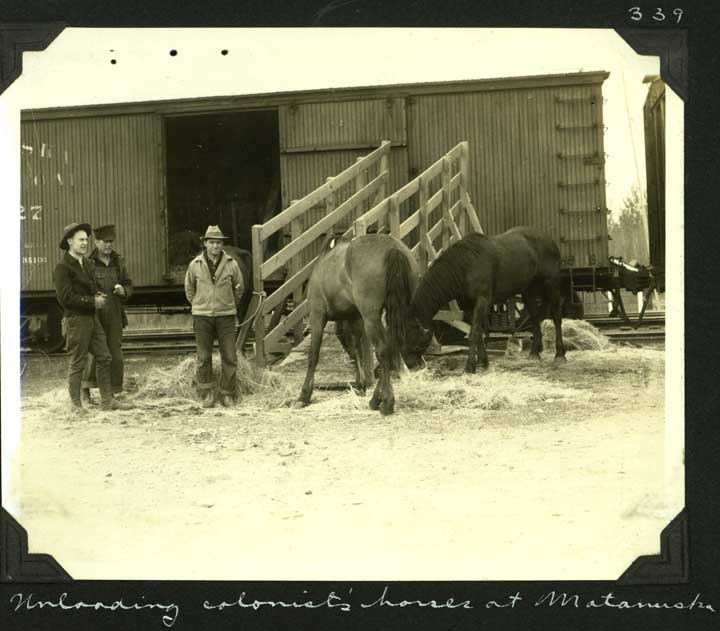
On May 29th, 1935, the last eight of the original families selected for the Matanuska Colony finally reached Palmer, along with their fellow passengers from the North Star – the Sherrod family, hired on to nurse the sick colonists quarantined in Seattle; and the 70 cows and 69 horses the North Star had originally planned to transport that voyage.
Arville Schaleben said seven families came in.
Norma Benson recalled eight families on the North Star: Ennises, Zooks, Larshes, Dragseths, Hoefts, Loyers, Nelsons, and Puhls.
Schaleben on Sherrods:
“Max H. Sherrod and his wife, both registered nurses, heard about the rural rehabilitation here, loaded their daughter, Janet, 3, in the family car and started for Seattle from Battle Creek, Mich.
‘We were lucky,’ Sherrod says. ‘We got a job on the North Star, nursing the sick kids who’d been left behind when the Wisconsin and Michigan families sailed on the St. Mihiel. Then we came on to Palmer. We just had a tent and a little baggage. But Irwin says we can have a little land and work part time at nursing.
‘Now this is the country for us. We’re through shifting around. I guess we’ll settle down and make things grow.’”
Locals know they did just that. Max Sherrod held the giant cabbage record at the Fair for years, and the junior cabbage growing contest is named in his honor.

AT article listing families
A list of the late-arriving families published in the Anchorage Times, June 4, 1935.

“Unloading colonists’ horses at Matanuska.”
From the official ARRC photo album, Mary Nan Gamble collection, Alaska State Library.

Arville Schaleben interviewed Max Sherrod a couple weeks after his arrival:
“Max H. Sherrod and his wife, both registered nurses, heard about the rural rehabilitation here, loaded their daughter, Janet, 3, in the family car and started for Seattle from Battle Creek, Mich.
‘We were lucky,’ Sherrod says. ‘We got a job on the North Star, nursing the sick kids who’d been left behind when the Wisconsin and Michigan families sailed on the St. Mihiel. Then we came on to Palmer. We just had a tent and a little baggage. But Irwin says we can have a little land and work part time at nursing.
‘Now this is the country for us. We’re through shifting around. I guess we’ll settle down and make things grow.’”
Locals know they did just that. Max held the giant cabbage record at the Fair for years, and the junior cabbage growing contest is named in his honor.

Excerpt from Arville Schaleben “Preacher Bingle, ‘Tex’ and Buttercup Help Colonists to Settle Matanuska,” Milwaukee Journal, May 16th 1935.
Max Sherrod recalled fifty years later:
“My wife Dorothy and I with our three year old daughter, Janet, arrived in Palmer by an ARRC bus from the Matanuska Depot, after the trip from Seward. . . The date was May 29, 1935, 6:30 a.m. . .
We were registered nurses from Battle Creek, Michigan with seven years hospital nursing experience. We had decided after four years of married life to move to Alaska, hoping to escape the depression and find a better life in a frontier area.
While in Seattle waiting for a boat departure, the last group of Matanuska Valley Colonists arrived at the Frye Hotel, where they were staying. The above seven families had various childhood diseases and it was decided to put them on the North Star, Bureau of Indian Affairs boat, that was taking about 80 horses, 85 cows, and a cargo of freight for the ARRC project. The men were to care for the livestock. We were offered first class passage in exchange for our nursing services for the seven families, making this the first full-time nursing service to be provided to these colonists of the Matanuska Valley.
In the first few days at the present Palmer townsite, at the north side of the present Palmer Elks Lodge, we established a tent-like structure, 16’ x 20’, as our temporary living quarters. We lived in this ‘home’ for a full year. This was a rugged way to spend the first year in Alaska. There was no electricity, only outside toilets, gasoline lamps, wood stoves, and the water had to be carried from a farm well 1/8th mile away. In the month of June we had a garden planted on John Bugge’s farm where we and others got our water. I was working in the warehouse as a laborer.”
Excerpt from Max Sherrod’s essay “Nursing in the Matanuska Valley,” in “The Matanuska Colony – Fifty Years 1935-1985” by Brigitte Lively.
Photo of Dorothy Sherrod’s dress and a loom used by the Sherrods, at the Colony House Museum.