On May 25th , 1935, several Army Medical Corps personnel of the St. Mihiel visited Palmer, to see where their passengers of the last two trips were bound.
Capt. Roland K. Charles Jr., MD, wrote a report for the Army Medical Bulletin soon after. His main subject was the role of the St. Mihiel in transporting the colonists, but he also provided a succinct description of the overall project, and a snapshot view of the Matanuska Colony at the time of his visit, with particular attention paid to its medical facilities.
As the outbreaks of measles aboard ship had foreshadowed, Palmer’s rudimentary tent hospital would be stretched beyond its limits over the next month and a half. Three children would die from complications of measles in late June and early July.
Article “Report All Well Happy at Palmer”
Anchorage Times, Monday, May 27th, 1935
Photo from the MSB Sandbote collection held by PMHA, “Col. Ohlson, Gen. Manager of Alaska Railroad.”
Capt. Roland K. Charles, Jr. wrote in his “Notes on the Matanuska Project”:
“The story of Matanuska is too recent to offer a proper perspective. It is like writing a war history during the conflict or just afterwards. This rural rehabilitation project is one of many instituted by The President throughout the country. However, the father of the Matanuska plan is Col. Otto F. Ohlson, general manager of the Alaska Railroad, the government railroad running from Seward to Fairbanks, with a short branch extending up the Matanuska valley to the old naval coal fields. . . Seven years ago he started a campaign in the states for settlers to move into the Matanuska Valley, which resulted in a few farmers moving into the locality. The period of depression which soon followed stopped this migration, and at present there are only a few scattered homesteads over the valley. When The President started the rural rehabilitation plans, Col. Ohlson renewed his efforts in Washington, sold the idea to the Secretary of Agriculture and the Secretary of the Interior, who in turn presented it to The President. The Federal Emergency Relief Administration then added this project to the many other rural rehabilitation projects throughout the country . . .”
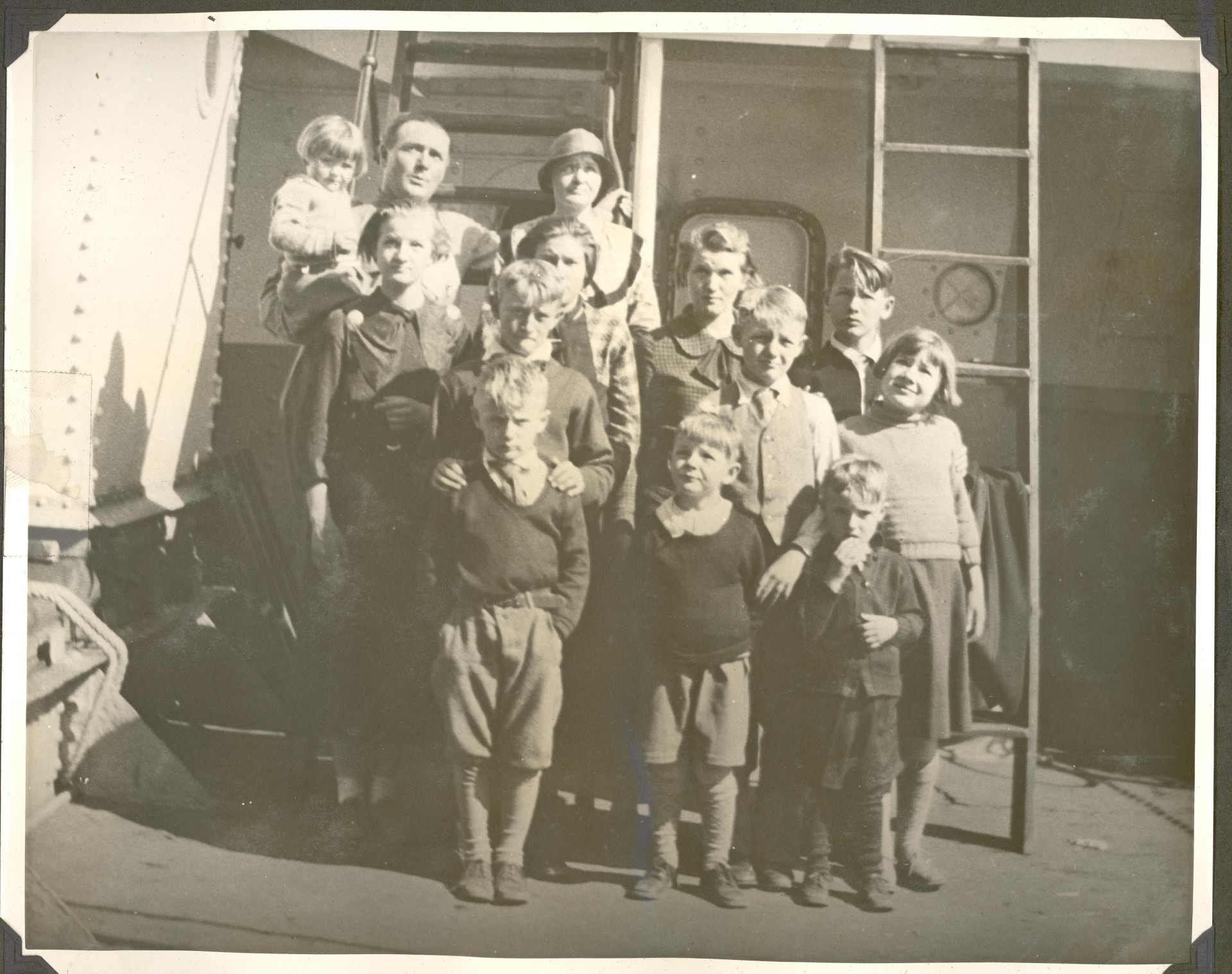
Photo of the Bouwens family en route to Alaska from the Sandbote collection.
“Roughly, the proposition is as follows: the Alaska Rural Rehabilitation Corporation is the governing body, and is a representative of the Government. The accepted family is to dispose of the property in the old home, severing all ties. Transportation for the family and a reasonable amount of household freight is allowed. A few pets can be taken along. Three thousand dollars is loaned at 3% interest to each settler, with interest and principal payments to start five years after entering the valley, and 30 years is allowed for amortization. A forty acre plot, 3 of which will be cleared, is to be given each settler, and the Government will build a log cabin of specified type on this property. The family will be furnished the necessities of life by the Government on memorandum receipt until it becomes self sustaining. All of this is charged against the three thousand dollars. . .
It is estimated that these people will begin to produce part of their living in two or three years, and that they will gradually work away from the indirect relief scheme. Also it is estimated that the amount spent by the Government for development of this project will not be in excess of that spent for direct relief of the same group for a period of years, and without the possibility of reestablishing them on an independent basis.”
Photo from the official ARRC album, Mary Nan Gamble collection, Alaska State Library. “Camp from top of water tank.”
“When I saw the valley there were two camps; one for the first contingent of settlers and one for the transient enrollees, both well established and functioning. About 7 other camps were being built at different parts of the valley for the newcomers. Two days before my arrival the settlers had drawn for their lots and were awaiting transfer to these several camps which were established in the locality of the lots drawn by the future occupants. In this way the settlers can walk to work on their respective area instead of being transported several miles from the central camp, which would be impossible during wet weather.”
Photo of tent living, summer 1935, from the Vasanoja family collection.
“The first contingent of settlers had made themselves comfortable in their tents to a remarkable degree, varying with the individual family characteristics for adaptability. They were housed in 16ft. by 20 ft. wall tents, with board floor and sidewalls. The tents were arranged in streets. Each family had a tent. Sufficient cots were issued to each family and many had the cots doubled and triple decked like the ship bunks. A cooking range was issued to each family which furnished heat as well as cooking facilities. Food was drawn from the commissary on memorandum receipt.”
Hewitt’s photo from the MSB Sandbote collection held by PMHA.
“One well was dug for each camp, with pump or windlass for drawing water. Regular dry pit privys were placed a reasonable distance from the camp and of sufficient number for the population of the camps. For the most part the first contingent of settlers were satisfied, and were looking forward to moving to their permanent areas where the log cottages would be erected.”
Photo from the ARRC album. “Base Hospital.”
“The hospital area is between the two camps on a knoll. It is composed of 4 tents of the same type as the camps have. There are two ward tents of 6 beds each, one tent for pharmacy and dressing room, and the fourth tent for the doctor’s quarters and an emergency surgery. All cases for hospitalization are sent 14 [sic – 41] miles to Anchorage to the Railroad Hospital on a railroad ambulance motor speeder.”
Photo from the ARRC album. “Dr. Ostrum holding the two babies that he attended.”
“The doctor has a very trying job on his hands and he will be unable to do the type of work he should until better housing is constructed. At present he has no means of transportation to the other camps, but hopes to get a saddle horse soon. The settlers were missing the easily accessible ship’ hospital and adequate medical attention at all times. The doctor was employed for care of the enrollees only, but when the settlers arrived their care was also wished on him, which increased his population from 500 to 1500.”
Photo from the ARRC album: “Raising Old Glory for the first time over the hospital, May 19, 1935. (L to R) W. Hawkins, nurse, Dr. E. A. Ostrum, Earl Ostrum nurse, Red Cross nurse Madeleine de Foras”
“The American Flag and Red Cross flag fly from a mast in front of this area. The Red Cross nurse stated that her flag had not been shipped with the supplies, so she used some old sheeting given her by the ship’s hospital for emergency diapers which was taken aboard in San Francisco from salvage, and some settler’s wife contributed a piece of red pajama cloth. Amid blasts of dynamite the American and Red Cross flags were hoisted above, with ‘U.S.A.T. GRANT’ visibly marked on one end of the Red Cross flag.”
Photo from the Sandbote collection: “The U.S.A.T. ‘ST. MIHIEL’ having completed the transportation of settlers is Homeward bound from Seward Alaska to San Francisco, California.”
“It is difficult to describe the intrinsic mental, emotional, administrative, and political phases of this project. No doubt this is the beginning of an historical undertaking and it is a pleasure to have participated to a slight extent in it. Also it is a privilege to be young enough to possibly see its further development.