
Press Coverage in the Colony
In mid-June of 1935, the Matanuska Colony Project was about to enter its most dramatic and contentious few weeks. There would be wild rumors, secret meetings, petitions and telegrams to political leaders, an epidemic, and a congressional investigation. In this daily narrative, now might be a good time to step back and consider how the story of the Colony was told at the time. Misinformation abounded, and ran the gamut from amusing to damaging. The Colony was never a small, tidy story; and within its ambitious and contradictory sprawl, even as it happened, we find everything from reporters mythologizing the heroic pioneers to politicians denouncing the project for supposedly bringing communism to Palmer.
Many people Outside had cartoonish notions of what conditions were like in Alaska, and were quick to scoff at the notion of sending farmers to the frozen north. The Matanuska project was also a political football – an ambitious New Deal relief program, guaranteed by its size and speed to run into logistical difficulties, which could be used by critics of the Roosevelt administration as examples of wasteful spending or government overreach.

A United Press report on May 13th, 1935 said:
“The Alaskan valley to which 1000 northwestern farmers are being sent with government subsidy was described today by Cyrenus Cole, former Iowa congressman, as a ‘de luxe Siberia’ where the colonists will ‘die or fail.’
Cole charged in a letter to Harry A. Wallace, secretary of agriculture that ‘semi-Sovietized America’ is emulating Russia in sending ‘victims of its professional dreamers to a de luxe Siberia called Alaska.
He pleaded with Wallace to halt the migration . . .”

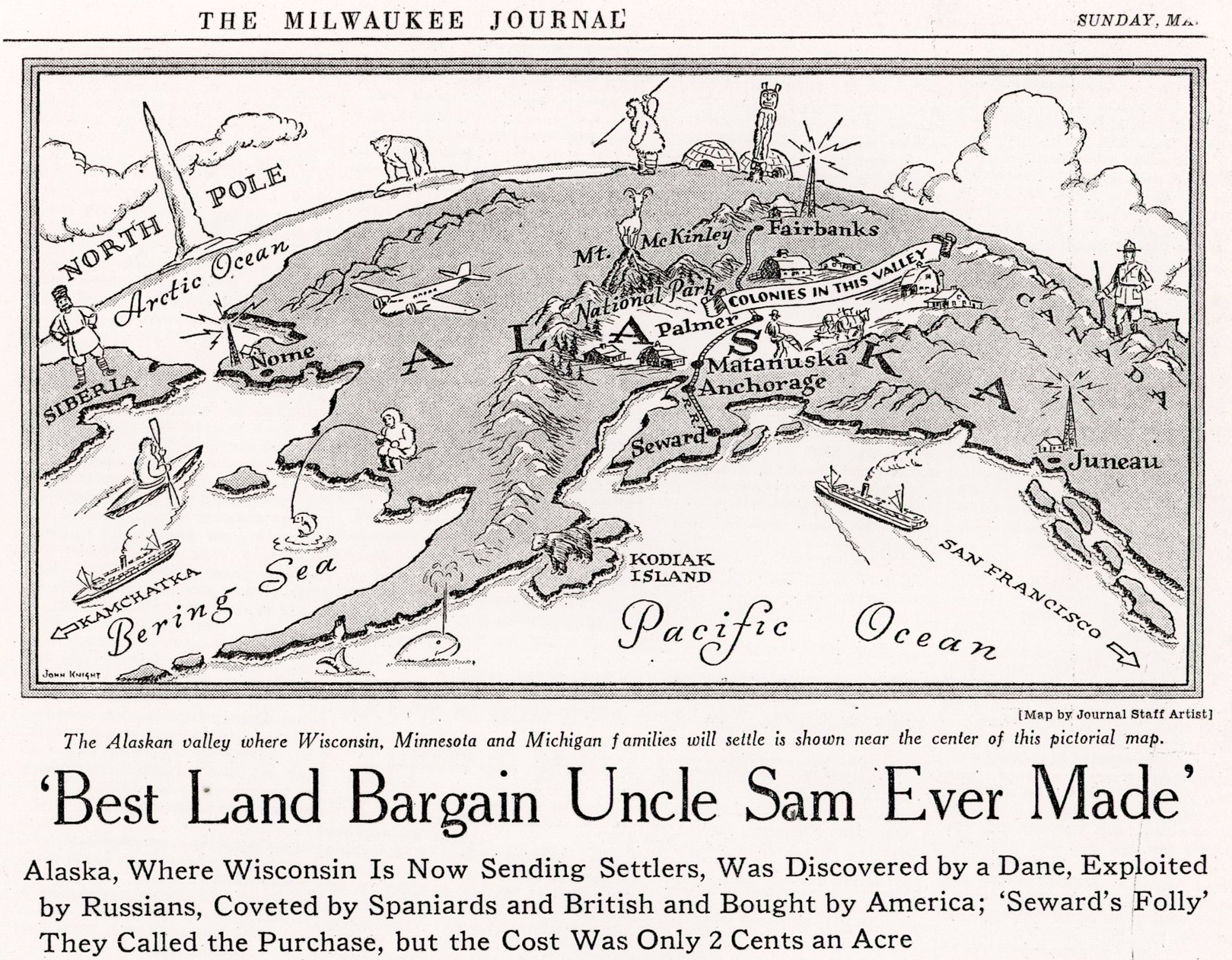
Map from the Milwaukee Journal, May 12th, 1935. From the Juster Hill collection held by Palmer Historical Society.
UP report quoted from the Imperial Valley Press (El Centro, CA), “Alaskan Project Is Denounced By Ex-Congressman,” May 13th 1935.

Odsather tent city with flag
After the events of the second half of June, which included colonists’ petitions and telegrams to elected leaders protesting conditions in Palmer, the rhetoric escalated. Senator Vandenberg of Michigan (a staunch opponent of the New Deal, who felt some of Roosevelt’s actions as president were usurping powers of Congress) called for an investigation of the Colony. He said “these people are left stranded 5,000 miles from home in the face of threatening calamity,” and of the farmers’ agreement with the ARRC “we have in net essence a complete commune under the American flag at Palmer, Alaska.”

Historian Orlando Miller wrote:
“Perhaps the earliest and most important failure of the Matanuska Colony was that it did not for long remain a dramatic and satisfying demonstration of a recovered pioneer past. When the colony was new it was pleasant to think that once it had been possible to escape towns and panics and to start fresh, but the journalistic accounts of the colony before long spoiled the pleasure of vicarious pioneering. . . There were no real dangers or privations and no crises except in the relations between the colonists and the management of the project.
The press’s treatment of the colony was affected not only by the disappointment of the reporters, who shared the myths and cliches of the frontier with their readers, but by an increasing general anti-New Deal slant in the press in the middle and late 1930s. . .
The increasingly unfriendly attitude toward the colony was not found in straight news stories from official sources but in magazine and newspaper feature articles, straining for color and written in the language of frontierism, and in editorials that showed a growing willingness to use the colony to embarrass the Roosevelt administration. Charges such as the one that colonists complained that they were not furnished electric refrigerators and washing machines free of charge were inaccurate and unfair – there was at that time, after all, no electric power system outside the community center – but they reflected the political slant of the press and the general disappointment in the colonists’ failure to measure up to the standards of pioneering the press itself had set for them.”

Photo from the official ARRC album of the Johnson’s house on tract 97.
The conflicting narratives of the colony were nicely untangled in Klaria Johnson’s balanced 1936 perspective on the project:
“I’m a ‘cream-puff pioneer’ – so designated by one of the many writers sent up here to ‘get the facts’ about this Government-financed farm colony in the Matanuska Valley. Since May, 1935, when Uncle Sam transported our little band of Middle Westerners to this Alaska scene, other scribes have dubbed us modern Pilgrims; heroic colonists; noble martyrs. Also loafers, social parasites, and bums.
But let the first soft impeachment stand; not that it’s accurate, but there’s humor in it – and a hint of verity. For while our colony life is certainly no bed of roses, neither is it pioneering in the traditional sense. I know, because my mother was born in a sod house on a North Dakota prairie homestead. Moreover, I taught school in Wisconsin farming districts, my specialty being early American history. And when it comes to a knowledge of real Alaska pioneering, my near neighbor is a sourdough farmer – and voluble. Call him a colonist, and he’s outraged. He slashed his way into this valley with a pack on his back to stake his homestead. Unaided, he has turned his section of wilderness into paying, cultivated acres, with livestock, barns, and a dwelling that makes it one of the showplaces of the Matanuska. But – to achieve his success he put in twenty years of grueling work and loneliness.”
…
“Tourists are always saying ‘Pretty soft for you colonists – having Uncle Sam footing all your expenses and giving you thirty years in which to pay your debt.’ Soft it would be, were Vic and I to sit down and hire our work done without regard to expenses. But each of us has averaged fourteen hours’ labor a day in order to keep our debt down to the lowest possible figure.
…
Though our comfortable circumstances are due, primarily, to our own unceasing labor, we realize that no amount of individual effort could have advanced us so far in only sixteen months had it not been for the modern facilities made available through Government aid.
That aid enabled us to reach Alaska and be housed within five months. It placed at our disposal the most efficient modern machinery for the clearing and cultivation of our land; supplied us with invaluable data on local soil, crops, and seasonal conditions through the eighteen-year records of the Matanuska Agricultural Experiment Station; and it extended the long-term credit which assures us the necessities while we are bringing our tract into profitable production.
That aid, contrary to a widespread misconception, is not donated by Uncle Sam. We are contracted to pay – with interest. We shall do it.”
From the chapter “I’m a Cream-Puff Pioneer” in Barrett Willoughby’s 1946 book “Alaska Holiday.”

Photo from the ARRC album. “As the cameramen grind away the new arrivals seek the location of their tents.”
“We had been given to understand that our exodus would be given no publicity. Judge of our consternation when we found attached to our train a corps of reporters, photographers, newsreel men, and sob sisters all intent on reporting our every action as ‘history in the making’! In addition, at every stop we were boarded by local newsmen who photographed and interviewed us; while civic dignitaries made speeches on the platform and brass bands played.
In transit or on siding, we could not escape…”
The publicity continued after the voyage. Johnson recalls of the first summer in Palmer:
“Even the mosquitoes proved far less formidable than we expected. A far greater annoyance was the swarm of journalists and cameramen who besieged us. . . And they caught us women at our embarrassing worst – snapping us at the washtub; or as we staggered from the commissary, hats awry and arms loaded with groceries; or when we were mired in the mud.
When we weren’t being photographed, we were being interviewed.”
From the chapter “I’m a Cream-Puff Pioneer” in Barrett Willoughby’s 1946 book “Alaska Holiday.”

An Associated Press photo which ran May 24th, 1935 with the caption:
“Typical of the homes in which the government colonists in Matanuska valley will live is this first log cabin built on the project.”
The cabin is actually Felton’s store, built by homesteader George White, one of the oldest structures in Palmer when the colonists arrived.
AP photo from the Hulbert/Fox collection.

Photo of Arville Schaleben from the ARRC photo album.
Don Irwin wrote:
“The colony had been great publicity and ammunition for opposing politicians. Now, they were finding that its banner headline appeal had worn thin. They were off on another tangent.
One reporter, Arville Schaleben of the Milwaukee Journal, was an exception. He was a conservative journalist. [Note – Irwin is using “conservative” not in the political sense, but meaning cautious, the opposite of sensationalistic.] He felt that this project rated more than a few days of exciting, inflammatory headlines. He dug deeply into what was going on. He was not afraid to walk, thumb a ride on a Corporation truck, or borrow a horse from a Colonist to ride, if he could get the exact information he wanted for his reports. It was not at all unusual to see Schaleben riding a horse bareback, at a lope, coattails, elbows, dispatch case and camera flying, hurrying to the railroad depot to file a deadline report for his paper. He was with the colony for four months. . . He is the kind of reporter this project or any project deserves and needs.”
From Don Irwin, “The Colorful Matanuska Valley” (1968), p 90.

Arville Schaleben, “Some Alaska ‘Farmers’ Now Don’t Like
Farming.” Milwaukee Journal, June 2nd
1935.
Schaleben was keenly aware of the effect of media coverage on the project, and though he indulged in the pioneer narrative as much as any reporter, he also poked holes in it.
“That hero stuff in the States swelled their hat bands. These Michigan and Wisconsin colonists got to telling each other that they had their Uncle Sam kicking in with a ‘millionaire’s vacation.’ . . . Loud now is the wail of the deflated vacationists.”

“All through 1935 newspaper reporters, magazine writers, those on assignment and free lance writers were as thick as mosquitoes before the compounding of DDT. Articles appeared in the magazines written by people who had spent a maximum of two days in Alaska. Garbled information, half truths, Colonists and management misquoted or statements taken out of context and used to applaud or condemn the project. The uncle of Vice President Henry Wallace came to the business office of the corporation and asked Irwin how he could help. ‘You know,’ he said, ‘I am a newspaper publisher.’ ‘Just keep this project out of the papers and let the people settle down,’ Irwin replied. ‘They have been in the public’s eye so long that some of them just want to keep it up. All along the way up here Washington promised them rifles, radios, and most anything else they asked for. As one Colonist said, ‘We are heroes.’ They are a good cross-section of most any rural community in the States. Just let them simmer down so they can get their feet on the ground. Most of them will make it, but they must forget the publicity.’”
Don Irwin, “The Colorful Matanuska Valley” (1968), p 90-91.