On May 10th, 1935, the Milwaukee Journal ran an entire article by their reporter in the Matanuska Valley just marveling at the quality of the dirt. Two hundred families had bet their future on Matanuska soil, and crops raised by the homesteaders and Experiment Station showed it was a good bet.
Clipping from Arville Schaleben, “Colonists Find Soil of Alaska Ideal for Their Crops”, Milwaukee Journal, June 10th 1935
Turnip grown at the Matanuska Experiment Station. From the PMHA Snodgrass collection.
A.A. Schonbeck’s hay dryer near Palmer, 1935. From the official ARRC photo album, Mary Nan Gamble collection, Alaska State Library. “Privately owned hay dryer in operation near Palmer. The hay is cut, dried, and stacked in one operation.”
Photo of John Bugge, early Palmer homesteader, from the PMHA Irwin collection.
Photo of John Bugge’s homestead from the PMHA Snodgrass collection. The field behind the cabin is the present site of Fred Meyer.
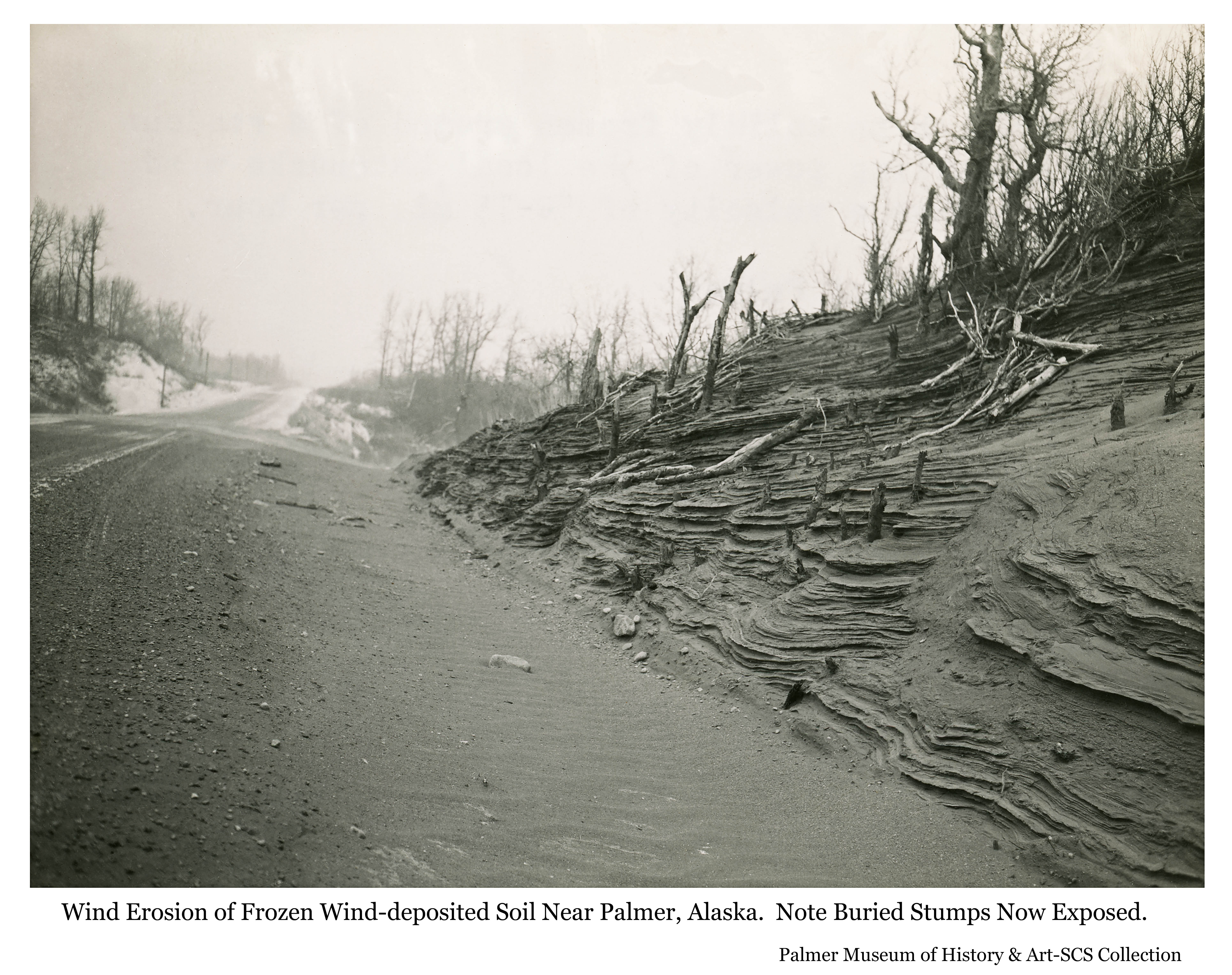
But the richness the glacial winds deposit, they can also scour away.
“Leave windrows when you clear the land,” Don Irwin advised the farmers on the morning of the land drawing. “This land blew in and it’ll blow out too.”
Photo from the PMHA Soil Conservation Service photo collection.
Irwin quote from Alanen, Arnold R. “Midwesterners in the Matanuska Valley: Colonizing Rural Alaska during the 1930s.” Perspectives in Vernacular Architecture 8 (2000): 53–80. https://doi.org/10.2307/3514407
The week of the 10th, was when Palmer’s newest residents got their first taste of wind and dust.
Clipping from Arville Schaleben, “Alaska Project Lags Badly, May Be Caught By Winter,” Milwaukee Journal, June 12th 1935.
What must those drought-stricken refugees have thought the first time the wind whipped up the river silt like a vision of the Dust Bowl come north?